

Outdoor Wedding Weather Plan in Jordan: Rain, Wind and Heat
Key facts
- A backup room must hold the actual seated layout, not only the venue’s headline capacity.
- Set the switch deadline according to the time suppliers need to reset and test the space.
- Use official local forecasts and warnings; no single rain probability or temperature fits every venue.
- Give guests and suppliers one confirmed update with the revised entrance and timing.
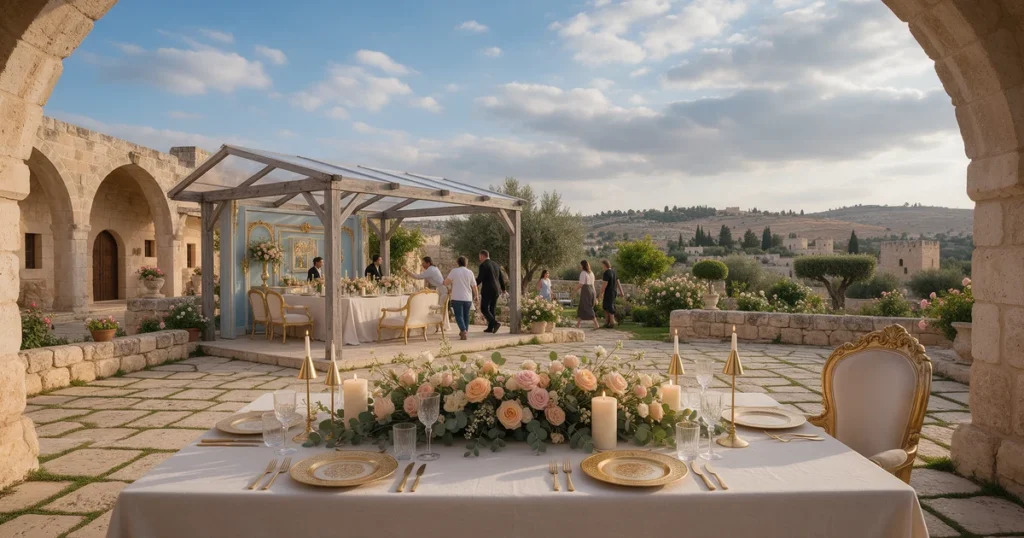
An outdoor wedding in Jordan needs more than a hopeful look at the forecast. The useful plan names an indoor alternative, the person who can activate it, a decision deadline, and the exact message guests and suppliers will receive. Prepare these details with the venue before you pay a deposit. If you are still comparing settings, read Farhetna’s indoor versus outdoor venue guide first. Here the focus is how to run the fallback once you have chosen an outdoor space.
Book a real fallback space, not just a promise
Ask to see the actual room, covered area or alternate venue that would be used if the garden or terrace becomes unsuitable. Have the operator draw the same event in that space: your expected number of guests, tables, stage or zaffe entrance, food stations, accessible routes, washrooms and exits. Farhetna’s venue capacity guide explains why an advertised number cannot replace a layout for your event.
Confirm whether the fallback is reserved exclusively for your date or could be committed to another event. If it is a tent or temporary cover, ask the venue and its specialist supplier about installation, anchoring, wind and rain suitability, drainage, safe power and their conditions for use. Have the operator and specialist supplier assess safe use; do not improvise structural decisions.
For a venue in a low area or near a wadi, inspect the approach road and drainage as well as the celebration space. Jordan’s Public Security Directorate warns against crossing floodwater or using wadis and low-lying areas during heavy rain.
Write the decision rule and its deadline
Agree with the venue on which conditions would prompt a move indoors, a delay or cancellation of outdoor activity. Consider an official warning, unsafe wind for the supplier’s setup, rainfall that makes routes slippery, standing water, poor visibility, or heat that cannot be managed for guests and workers. No rainfall percentage or temperature fits every site; ask its operator and suppliers to assess safe use.
Write down who has authority to make the call and who substitutes if that person cannot be reached. Choose a decision deadline that leaves enough time to reset the floor, test power and sound, redirect arrivals and inform families. Ask what happens if conditions change after that point, including during the ceremony or between the ceremony and dinner.
At booking, agree on the cost of moving furniture and décor, supplier overtime, a different catering layout, transport changes and any date change or cancellation conditions. A written annex can include a floor plan, timing, charges and contacts. Keep the final agreed version with the contract.
Monitor the right place and the right hour
Check the Jordan Meteorological Department forecast and warnings for the wedding area, and recheck as the date approaches. Its site provides forecasts by city and a four-day outlook; a distant long-range prediction should not be treated as a firm event-day decision. Check the hours of arrival, ceremony and return, not only the daytime maximum. Ask the venue to compare the published outlook with conditions on site, especially where elevation and exposure differ from the nearest city.
Make a short review schedule with the coordinator and venue, for example when the short-range forecast first becomes relevant, the previous day, and before vendors load in. Follow current official warnings and the venue’s safe-use instructions if conditions change quickly.
Outdoor Wedding Weather Plan Checklist
Seven checks for the fallback room, weather decision and guest update.
Prepare separate responses for rain, wind and heat
For rain, trace every route from the guest drop-off to the ceremony, dining area and washrooms. Check surfaces, drainage, covered waiting space, electrical equipment and how a wet layout affects dresses, shoes and mobility aids. Arrange a staffed entrance and waiting area during the reset.
For wind or blowing dust, ask the venue and suppliers who decides whether backdrops, floral structures, lighting, temporary signs and tents can remain in place. Agree on simpler indoor décor, professional securing of objects and clear exits.
For heat, offer water at arrival, shade or an adequately cooled indoor space, and seats for guests who need to rest. Move long waiting periods and photo queues out of direct sun. Jordan’s Public Security Directorate’s heat guidance emphasizes avoiding direct sun, drinking water and taking breaks, particularly in areas such as the Jordan Valley, Dead Sea and Aqaba.
Give every supplier the same version of the plan
Photographer, videographer, florist, decorator, caterer, sound team and zaffe provider each need the indoor address or exact room, load-in route, decision time and revised running order. Assign the indoor photo spot, zaffe entrance, catering station and sound test. Send one dated plan to all of them and ask each to flag a task that cannot be completed within the switch window.
Nominate one day-of coordinator, whether a hired planner or a trusted person who is free from greeting guests, and one venue contact. The coordinator should have the current floor plan, vendor phone numbers, group message text and the authority agreed with the venue.
Tell guests exactly what changed
Send a short Arabic or English message as appropriate: the event is proceeding, the ceremony is now in the named hall, use this guest entrance and parking area, arrive at this time, and contact this day-of number if needed. Share a tested map pin for the guest entrance; a venue’s general pin may lead to a service gate. Farhetna’s guest transport guide can help align shuttles and return trips with the revised entrance.
Ask a family representative to call older relatives or guests who may miss a group notification. Put a person or sign at the original approach to redirect late arrivals. Avoid sending several conflicting versions through different family groups; issue one confirmed update and correct it in the same channels if the plan changes again.
Run the plan once before the wedding
At the final venue visit, walk the move as if it were happening: where guests wait, who moves each item, how long the reset takes, whether accessible entry remains open, and what happens to photos and the zaffe. Ask the venue to point to the usable backup space and identify the person on duty.
For the initial shortlist, browse Farhetna wedding venues and ask each operator to show the weather fallback for your date and guest count. A practical weather plan preserves the celebration’s essential moments while giving the team permission to change location promptly when conditions require it.
Common questions
When should we decide to move an outdoor wedding indoors?
Agree a deadline with the venue based on how long it takes to reset seating, food, sound and guest routes. Recheck the current official forecast and warnings close to the event, and allow an earlier decision if the operator says the outdoor setup cannot be used safely.
Is a tent enough for rain at a wedding in Jordan?
It depends on the site and professionally assessed structure. Ask the venue and specialist supplier about anchoring, wind and rain suitability, drainage, safe power, covered guest routes and seated capacity. Confirm a usable indoor alternative if the tent cannot be used.
Editorial trust
Sources
Related stories

How to Plan Wedding Guest Accommodation in Jordan
Help out-of-town guests find a suitable stay near your Jordan wedding. Compare complete room offers, clarify who pays…
How to Plan Wedding Guest Transport in Jordan
A practical arrival and return plan for wedding guests in Jordan, covering the guest gate, parking, shuttle seats…
How to Check a Wedding Venue’s Real Capacity in Jordan
A hall’s advertised number is only the start. Confirm the approved room limit and test your actual tables,…